The priorities, challenges, and policy proposals listed here reflect the most current information available. As community needs evolve, new data emerges, and residents continue to share their concerns, these issues may be updated to ensure accuracy, transparency, and alignment with what matters most to the people of Daytona Beach.



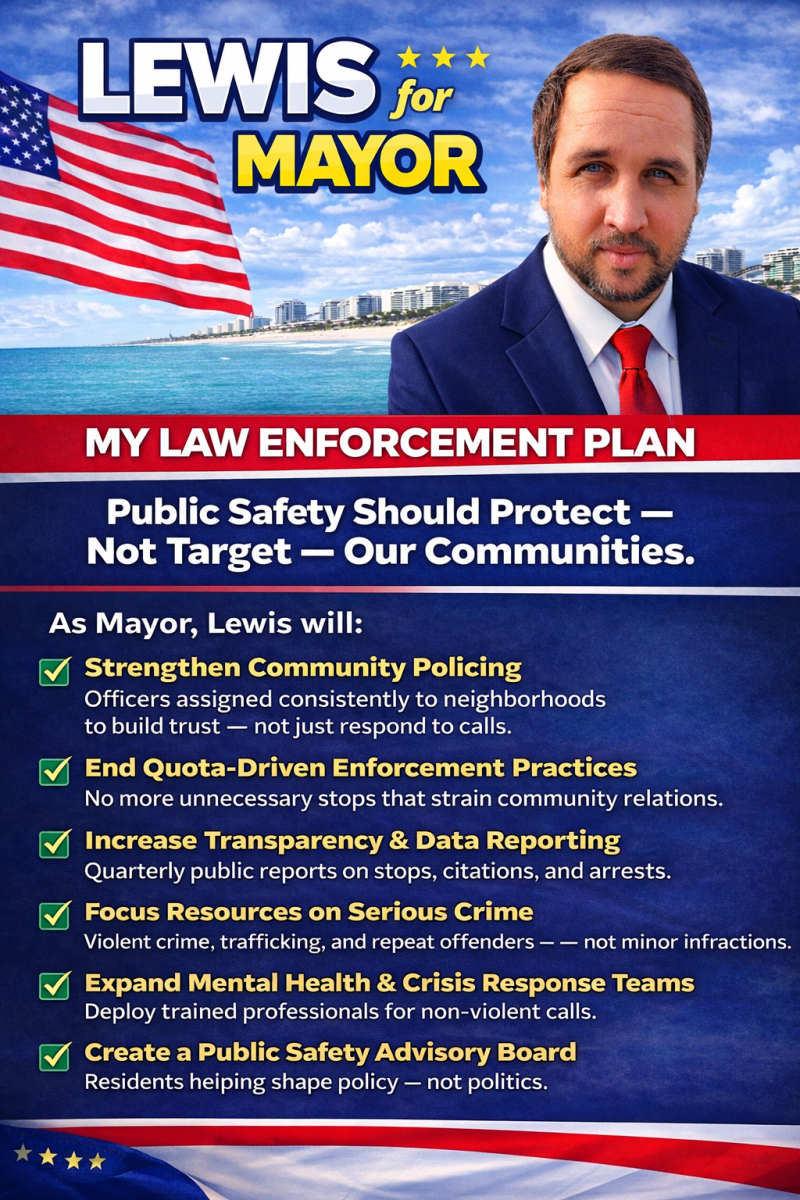

LAW & ORDER
As Mayor, I intend to address these issues directly and structurally. My commitments are as follows:
★ ACCURATE CRIME REPORTING Classify all complaints by Florida law, not personal preference.
★ INDEPENDENT REVIEW PROCESS Allow residents to challenge misclassified reports.
★ QUARTERLY AUDITS Publicly report on front-desk practices.
★ PROTECT WHISTLEBLOWERS Safeguard employees who report misconduct.
★ WHITE-COLLAR CRIME TRAINING Expand skills to tackle financial crimes.
★ ACCOUNTABLE LEADERSHIP Enforce standards & integrity.
★ TRANSPARENT CONTRACTING End political favoritism & backroom deals.
★ RESIDENT OVERSIGHT Empower the public to review city services.
SAFE. FAIR. ACCOUNTABLE.

LEWIS FOR MAYOR
PROTECTING OUR HISTORY. PRESERVING OUR FUTURE.
A Clear Commitment to Our City’s Heritage
✔ Save the Campbell Hotel
✔ Preserve Our Historic Landmarks
✔ Review Every Historic Site—Open & Transparent
✔ Establish a City Preservation Board
Our residents care deeply about the story of this city—
what shaped us, what we’ve lost, and what we must protect.
Under my leadership, that story will be protected.
The Campbell Hotel is more than a building.
It is part of our identity—and it deserves action, not neglect.
By creating a Preservation Board, we will bring
accountability, oversight, and long-term protection
to the places that tell our story.
Our history is not an afterthought.
It is a priority.
LEWIS FOR MAYOR
Honoring Our Past. Building a Stronger Daytona Beach.

LEWIS FOR MAYOR Partnering with BETHUNE-COOKMAN UNIVERSITY Honoring the Legacy of Dr. Mary McLeod Bethune
OUR COMMITMENT TO BETHUNE-COOKMAN UNIVERSITY
-
REAL PARTNERSHIP • Mayor's Roundtable with B-CU
-
CAREER PATHWAYS • Jobs & Internships for B-CU Students
-
NEIGHBORHOOD REVITALIZATION • Safer & Stronger Communities
-
CELEBRATING HERITAGE • Honoring B-CU's History & Culture
LEADERSHIP. OPPORTUNITY. PROGRESS. LEWIS FOR MAYOR A Commitment to Education & Excellence!

LEWIS FOR MAYOR DAYTONA BEACH, FL
TIME FOR TERM LIMITS IN THE MAYOR'S OFFICE
For too long, Daytona Beach has been led by the same voices, the same insiders, and the same politics—while residents are left waiting for real change.
TERM LIMITS MEAN:
✔ New leadership, not career politicians
✔ Fresh ideas instead of recycled promises
✔ Accountability to voters, not special interests
✔ A government that serves people, not power
LEWIS BELIEVES LEADERSHIP SHOULD BE EARNED — NOT INHERITED.
LEADERSHIP SHOULD ROTATE. POWER SHOULDN’T STAGNATE.

Statement on First Step Shelter
As Mayor, I will use every tool within my legal authority to ensure that First Step Shelter is reformed and rebuilt into a system that truly serves our community. That means exercising the full scope of powers entrusted to the office — from budget oversight to executive directives, from appointments to public accountability.
Through budget oversight, I will demand a complete audit of how taxpayer dollars are spent, ensuring that every cent is directed toward programs that deliver measurable results. Waste, mismanagement, and inefficiency will be exposed and eliminated.
Through executive directives, I will set clear standards for transparency, reporting, and performance. Shelter operations will no longer be allowed to drift without accountability. Instead, they will follow strict guidelines that prioritize compassion, efficiency, and transformation.
Through appointments, I will ensure that leadership positions are filled with individuals who are committed to reform, not to maintaining the status quo. If current management cannot meet the standards of accountability and effectiveness, they will be replaced with leaders who can.
Through public accountability, I will require regular reporting of shelter outcomes — how many people are housed, how many find jobs, how many break free from cycles of poverty. These reports will be made public, because the people of this city deserve to know how their resources are being used.
Where state or federal law limits action, I will not stop at the boundaries of city authority. I will advocate for reform at every level of government, building partnerships with county agencies, state legislators, and federal programs to expand services and secure funding. Reform cannot happen in isolation, and I will ensure our city is a leader in collaboration.
This is not just about managing homelessness — it is about ending it through accountability, transparency, and compassion. As Mayor, I will dismantle systems that fail, rebuild programs that work, and demand results that reflect the dignity and humanity of every person in our community.

LEWIS FOR MAYOR DAYTONA BEACH DESERVES BETTER
BROKEN METERS. BROKEN PROMISES.
Families across Daytona Beach are being hit with OUTRAGEOUS WATER BILLS caused by faulty, outdated, and poorly maintained meters.
These are NOT GLITCHES. They are the result of YEARS OF NEGLECT.
When residents complain, they're ignored. When neighborhoods speak up, they're told to wait. Meanwhile, bills keep rising.
✅ CITY HALL KNEW THE METERS WERE FAILING.
✅ CITY HALL KNEW RESIDENTS WERE BEING OVERCHARGED.
✅ CITY HALL FAILED TO ACT.
That's not leadership. That's abandonment.
AS MAYOR, LEWIS WILL:
✅ Audit and replace faulty water meters
✅ Demand transparent billing reviews
✅ Refund residents who were overcharged
✅ Hold departments accountable — no excuses
END THE ERA OF NEGLECT FIX THE SYSTEM
LEWIS FOR MAYOR REAL ACCOUNTABILITY. REAL RESULTS.

LEWIS FOR MAYOR A Mayor Focused on Fixing Our Roads
THE PROBLEMS:
-
Potholes and deteriorating roads
-
Dangerous intersections
-
Limited public transit options
-
Poor pedestrian and bike safety
LEWIS’S SOLUTIONS:
-
Launch a 24-month Road Repair Blitz prioritizing worst-condition streets
-
Upgrade traffic signals and timing systems to reduce congestion
-
Expand Votran routes and frequency to connect workers to jobs
-
Build safer crosswalks and bike lanes in high-traffic corridors
-
Create a Transportation Innovation Office to plan long-term mobility solutions
LEWIS FOR MAYOR A Mayor Focused on Fixing Our Roads

BEACH SIDE STR'S
Short‑term rentals are part of our city’s future, but they must be managed responsibly. As Mayor, I will ensure STRs strengthen our community instead of undermining it.
✅ Protect Neighborhood Integrity – Beachside residents deserve peace, safety, and stability. STRs should never disrupt the character of our neighborhoods.
✅ Respect Property Rights – Homeowners have the right to responsibly use their property. Clear, consistent rules will protect both residents and hosts. ✅ Enforce Compliance – STR operators must follow city codes, pay required taxes, and meet safety standards. Enforcement will be firm but fair.
✅ Support Tourism – STRs can boost our local economy by welcoming visitors. Responsible rentals benefit everyone.
✅ Community‑First Solutions – I will listen to residents, business owners, and visitors to craft policies that reflect Daytona Beach’s values.
Beachside is one of our greatest treasures. My commitment is to protect its character while allowing responsible growth. STRs should serve the community—not disrupt it.
Lewis for Mayor — A Long‑Term, Time‑Consuming but Necessary Investment in Our Teachers
Our campaign believes that if we want strong schools, we must start by supporting the people who make them work. That means giving our teachers not just respect, but real stability — including a path to affordable housing. This idea is bold, practical, and absolutely achievable, but it’s also important to be honest with residents: this will be time‑consuming. Real structural change always is.
Building on What Already Exists
The federal government already uses student loan incentives to attract and retain teachers. That proves something powerful: When we value educators, we build systems to support them.
Now it’s time to expand that support beyond the classroom and into housing — one of the biggest barriers teachers face.
Our Plan for Teacher Housing Support
1. Partnering with HUD and Federal Agencies
We will pursue federal programs and grants that help cities create workforce housing. This includes expanding eligibility for teachers and other essential workers. These partnerships take time to negotiate, but they are worth every hour.
2. Low‑ or Zero‑Interest Home Loans for Teachers
Using the same infrastructure that supports student loans, we will work with local lenders to create special mortgage products for educators. This won’t roll out overnight, but it lays the foundation for long‑term stability.
3. Affordable Workforce Rentals
Not every teacher is ready to buy a home. That’s why we will develop rental options specifically for school employees. Creating these units, securing agreements, and aligning incentives is a time‑consuming process — but it’s essential.
4. Incentives for Landlords Who Support Educators
We will introduce tax credits and other incentives for landlords who commit to offering affordable rents to teachers. Designing these programs, passing them through the proper channels, and ensuring accountability will take time, but it will pay off for decades.
5. A Realistic Timeline with Real Results
This is not a quick fix. It requires coordination with federal agencies, local lenders, developers, and landlords. It requires legislation, negotiation, and community engagement. But the systems already exist — and with the right leadership, we can expand them.
Our Commitment
Lewis is committed to doing the hard, time‑consuming work required to make this vision real. Because a city that cannot house its teachers cannot claim to value education. We will invest the time, the effort, and the political will to build a city where educators can afford to live in the communities they serve.


LEWIS FOR MAYOR
Mayor’s Library Advisory Council
A Stronger Library. A Stronger Community.
As Mayor, I will establish a Mayor’s Library Advisory Council — a diverse coalition of voices working together to shape the future of our public libraries.
Council Members Will Include:
• Librarians
• Teachers
• Parents
• Teens
• Seniors
• Business Leaders
Their Mission:
✔ Identify community needs
✔ Shape innovative programs
✔ Build public support
✔ Guide long-term planning
This initiative ensures our libraries remain centers of learning, opportunity, and connection for every resident.
Leadership. Transparency. Community Partnership.
Lewis for Mayor

Short‑term rentals are part of our city’s future, but they must be managed responsibly. As Mayor, I will ensure STRs strengthen our community instead of undermining it.
✅ Protect Neighborhood Integrity – Beachside residents deserve peace, safety, and stability. STRs should never disrupt the character of our neighborhoods.
✅ Respect Property Rights – Homeowners have the right to responsibly use their property. Clear, consistent rules will protect both residents and hosts.
✅ Enforce Compliance – STR operators must follow city codes, pay required taxes, and meet safety standards. Enforcement will be firm but fair.
✅ Support Tourism – STRs can boost our local economy by welcoming visitors. Responsible rentals benefit everyone.
✅ Community‑First Solutions – I will listen to residents, business owners, and visitors to craft policies that reflect Daytona Beach’s values.
Beachside is one of our greatest treasures. My commitment is to protect its character while allowing responsible growth. STRs should serve the community—not disrupt it.

Between Mason Avenue and Beville Road, US‑1 has become one of the most dangerous stretches in America for anyone who isn’t inside a vehicle. And for years, Daytona Beach leaders have failed to advocate for the most basic safety infrastructure: usable, continuous sidewalks for people with disabilities, seniors, and everyday pedestrians.
As a wheelchair user, you shouldn’t have to risk your life just to travel a mile. No resident should.
Everywhere else in Florida, cities are building modern, ADA‑compliant sidewalks, lighting, and crosswalks. Yet here in Daytona Beach, the silence from City Hall on this issue has been unacceptable. Residents have been asking for safe mobility for years. The need is obvious. The danger is real. The excuses have run out.
This isn’t complicated.This is about safety, dignity, and equal access.
As mayor, I will push for:
A full sidewalk and mobility audit of US‑1
Immediate design and funding of ADA‑compliant sidewalks between Mason and Beville
Safe crossings, lighting, and curb ramps
A mobility plan that finally includes people in wheelchairs, walkers, strollers, and on foot
Daytona Beach should never be a city where residents feel ignored or unsafe. We deserve leadership that advocates for us—not leadership that waits for another tragedy.
It’s time to replace inaction with responsibility.It’s time to build a city where everyone can move safely.
— Lewis for Mayor

Full Details Coming Soon

We will take restorative justice head on, with a clear mayoral initiative that puts accountability, healing, and community safety at the center of our work. Daytona Beach deserves a system that repairs harm, restores trust, and ensures every resident is treated with dignity and fairness. As mayor, I will lead that effort with transparency, courage, and a plan rooted in real results—not rhetoric.